
60% of Telcos will abandon AI projects. Understanding is the missing foundation
Network transformation is no longer a choice but a necessity. In the last decade, CSPs have effectively solved the “data collection” problem, but many operators today still struggle with the "data understanding” problem, because they have yet to turn vast complex data into a system that can understand dependencies, assess impact, and support automated decision-making with confidence.
Fragmented and legacy tools, siloed information, scattered topology and manual triage have all created a paradox: the more complex your network, the harder it is to understand, operate and automate it.
In a 2026 global survey of telecom leaders, 90% said AI is already helping increase revenue and reduce costs, and 65% pointed to network automation as the primary AI driver, forcing operators to rethink how they monitor, validate, and optimize their networks.
Four Pillars of AIOps that Ontology Powers.
Ontology gives AIOps a real time semantic map of your network, so teams can understand, and resolve complex issues in minutes, with confidence.

Pinpoint service impact in seconds, not hours.
When a fiber cut hits, a software update causes chaos, or a node goes dark; the first question is always the same: who's affected? In most CSPs, answering that question confidently can take hours if not days. Engineers manually and tediously trace dependencies across disconnected Operational Support Services (OSS), Network Management Systems (NMS), and Business Support Services (BSS) platforms. Customers call before your team even knows there has been a service interruption, creating frustration and risking customer churn.
Ontology models service topology and network telemetry end-to-end, from physical infrastructure through logical and transport layers to customer-facing services and encodes them in the semantic digital twin using a telco-specific knowledge graph. When a fault occurs, every impacted service, customer, and SLA is surfaced instantly.
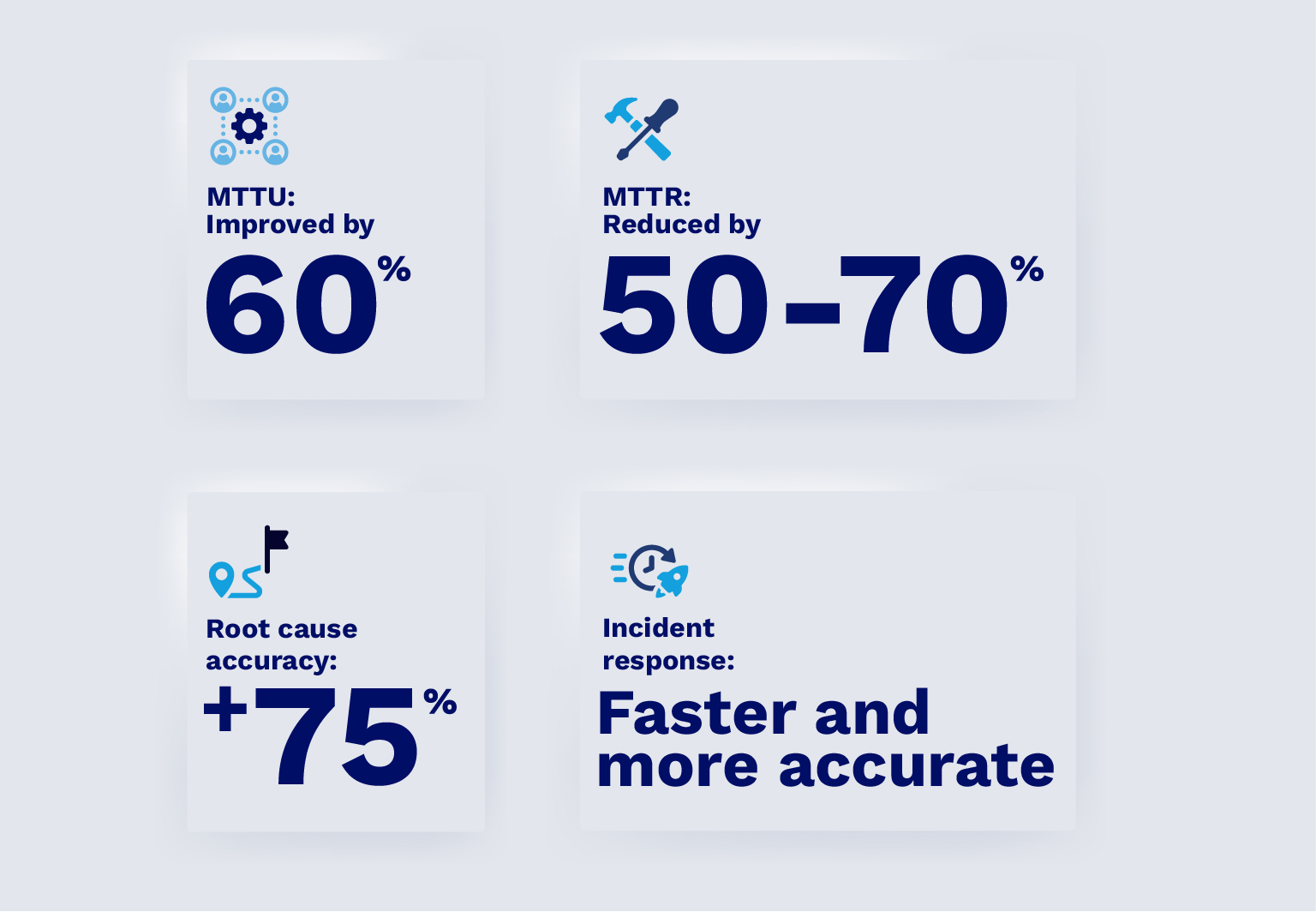
Mean Time to Respond, Repair, Resolve & Recover (MTTR) drops from hours to minutes, empowering your team to solve for the problem before customers are impacted.
Stop feeding your AI unqualified data.
Here's the uncomfortable truth behind most failed AI initiatives at CSPs: the data is unreliable. Duplicate records, stale inventory, conflicting sources across OSS and network systems, all feeding downstream analytics and automation with inputs nobody trusts.
Periodic, manual cleansing exercises are outdated the moment they finish. Ontology continuously validates data from your source systems against a single authoritative semantic model, providing ongoing, governed integrity built on telco-specific rules and inferences.
Fuel your AI and automation projects with trusted, high-quality network meaning and relationship context, so data drives innovation instead of holding it back.
See the full surface of attack before attackers do.
You can't secure what you can't see. 88% of security exposures stem from misconfigurations and policy gaps, not sophisticated hacks or attacks.
In complex multi-vendor environments these gaps are almost inevitable: undocumented IPs, unauthorized changes, and security policy deviations lurking in your network.
Ontology gives every asset a clear owner and risk context within a unified network graph. It continuously audits IP integrity, detects policy deviations, and maps security exposures across every domain and device, dynamically. Security should keep up with your network’s evolution, not hold it back.
Bypass the war room. Automate Root Cause.
Nearly 91% of IT war rooms react to incidents without identifying the right root cause, creating costly rework, high stress, and low morale driven by manual root cause analysis (RCA) and unmanaged tension.
Ontology bypasses that scenario by ingesting alarm information across domains, reasoning across the dependencies, and surfacing the most probable common root cause in minutes, not hours or weeks.
The result? Thousands of raw alerts are compressed into a ranked, actionable fault list. We helped CSP's increase the accuracy of their root cause analysis by 75%, leading to MTTR reductions of 50–70%. As a result, engineer’s can spend less time drowning in alerts and symptoms and more time on network planning, optimization, and more.
The Common Thread
These aren't four isolated challenges requiring four separate tools. They are symptoms of a single underlying issue: networks have become too complex to manage, operate, and automate without a shared understanding of how everything connects, behaves, and impacts the customer.
NumoData Ontology is that missing foundation. As a technology, and vendor-agnostic semantic digital twin, Ontology unifies cross-domain data into a single, continuously validated model. It understands dependencies, reasons over impact, and provides the trusted data AI and automation need to act with confidence.
With Ontology, operators move from reactive operations to predictive, autonomous networks, turning complexity into clarity, data into intelligence, and AI ambitions into real outcomes for customers.