
From automation to autonomy: accelerating autonomous networks with closed loop intelligence
Telecommunications networks now underpin every aspect of modern life, yet as 5G rollouts accelerate and 6G looms, operators face a costly reality.

Authors:
Subhankar Pal, Senior Director, Innovation, Capgemini
Stephane Lagain, Product Line Manager, AI Ops, NumoData
The hidden cost of semi-automated networks
Today's manual and partially automated processes are breaking under complexity: 70% of engineers today, spend 38% of their time on reactive troubleshooting rather than strategic optimization, CapEx investments in new technology sit underutilized because operations teams lack visibility to tune performance, and OpEx continues climbing as every new deployment adds another disconnected tool requiring specialist knowledge to operate.
The problem is not a lack of automation. Most operators have automated individual tasks, reaching states of level 1, 2 and 3 autonomy which consists of basic scripts, and workflows. The missing piece is intelligent autonomy (Level 4 and beyond): systems that observe conditions across layers, understand dependencies, reason about impact, and take actions that are explainable and aligned with business outcomes. Without this progression to true autonomous networks, operators remain trapped in a cycle where faster execution without contextual understanding amplifies risk rather than reducing it.
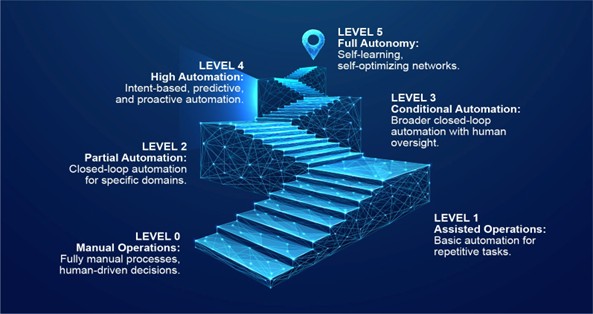
The manual reality: how networks operate today
A typical network incident today follows a frustratingly manual path. An alarm fires in one monitoring system. An engineer logs into multiple consoles to correlate data across domains. They manually assess which customers might be impacted by checking subscriber databases and service mappings. They investigate potential root causes by examining recent changes, comparing current performance to historical baselines, and testing hypotheses one by one. If remediation is needed, they open change tickets, wait for approval windows, and execute fixes while hoping no unintended consequences emerge.
This process stretches Mean Time To Understand and Repair into hours or days. Less than a third of remediation actions are automated. Network operations centers chase symptoms across disconnected systems, and the gap between network complexity and human capacity widens every day, with every fibre deployment and 5G rollout creating new data silos, new consoles, and new reporting requirements that fragment visibility further.
The cost is measured not just in operational efficiency but in customer experience: dropped calls during business hours, degraded video quality for premium subscribers, and extended outages that erode trust and revenue. As networks evolve toward fully autonomous operations, the industry must bridge this gap between simple task automation and intelligent, intent-based autonomy.
Closed loop automation: the foundation for autonomy
Closed-loop automation changes the operational paradigm by continuously assessing network conditions, traffic demand, and resource availability to optimize service quality without constant human intervention. Rather than waiting for complaints or manually adjusting parameters, CLA systems monitor, analyze, decide, and act in continuous cycles, with each action informed by real-time network state and operator-defined business priorities.
Real-world impact: where CLA makes a difference
Congestion management: Robust CLA systems detect congestion and degradation in specific network segments, automatically reprioritize traffic, and adjust quality of service parameters within minutes rather than hours. This prevents service degradation from reaching customers and preserves experience for premium services during peak demand periods.
“Operators using AI-driven closed-loop automation report shifting congestion handling from hours to minutes, with studies noting up to 55-60% reductions in MTTR and significant drops in congestion-related incidents.”
Source: International Journal of Science and Research Archive, 2025
Predictive analysis and self-healing: CLA systems detect anomalies across multi-domain telemetry, establish correlations to identify likely root causes, and trigger automated remediation workflows with minimal or no human intervention. Issues are discovered and resolved before customers experience impact, transforming operations from reactive incident management to proactive service assurance.
Experience-driven optimization: The end goal of intelligent CLA is continuously mapping network KPIs to customer experience and automatically fine-tuning services to protect premium offerings and high-value segments. This aligns technical performance with business outcomes, ensuring that optimization efforts focus on what matters most to customers and revenue.
“In large rollouts, AI-led automation has been linked to 25-30% reductions in operational cost, largely by avoiding congestion-related incidents and reducing dependency on manual intervention and training.”
Source: ComputerWeekly
The next evolution: from scripts to self-learning systems
Today's agentic AI represents a fundamental shift from static rules and scripts to adaptive, self-improving systems. Modern agents can re-route traffic, modify network slice parameters, escalate issues to planning teams, or open customer support cases, with every action automatically logged and evaluated to improve future decisions.
The era of human-intensive automation design has ended. Rather than operators spending weeks or months scripting workflows for specific scenarios, agentic AI learns patterns, adapts to changing conditions, and handles novel situations by reasoning about network state and business objectives. This represents the bridge from simple automation to true autonomy, enabling the progression from Level 2 basic automation to Level 4 autonomous operations where systems make informed decisions with minimal human intervention.
The intelligence layer: why semantic understanding changes everything
While closed-loop automation provides the operational backbone, Network AI and Semantic Digital Twin technologies determine how effectively the loop can recognize and reason about complex networks. This distinction matters because AI excels at finding patterns and correlations, but the semantic digital twin provides the causality - the "why" behind events that enables trustworthy autonomous decisions.
Semantic digital twins: beyond maps to reasoning engines
A semantic digital twin transcends static network maps to become a live reasoning engine that understands how the network works. Built on knowledge graph and ontology first principles specifically designed for telecommunications, it encodes not just what elements exist but how they relate, depend on each other, and impact services and customers.
The distinction matters: traditional digital twins provide a high-resolution image of a machine; semantic digital twins provide the detailed explanation of how every part interacts with everything else and what impact they have on overall operational efficiency. This is not visualization - it is semantic reasoning that operates beyond simple correlation to explain why events occurred together by tracing cause-and-effect through the model.
For example, when a hub router shows degraded performance, the semantic twin does not just correlate this with customer complaints. It reasons through the model to show which specific customers and services will be affected, which alternative routes best mitigate that risk, what dependencies exist across network layers, and what business impact different remediation choices will create. This causal analysis enables autonomous systems to make decisions that are not just fast but also grounded in truth and explainable.
Network AI: proactive recognition before problems become outages
Network AI converts massive telemetry streams into actionable intelligence through proactive pattern recognition and predictive analytics. By continuously analyzing performance across network layers, it spots anomalies early - often hours before they escalate into customer-impacting events. Machine learning models predict likely failure patterns based on historical data, current conditions, and network behavior, enabling operators to recognize issues in the "pre-incident" phase when remediation is simpler and less disruptive.
This proactive recognition aligns with the "recognize and reason" capabilities in autonomous network maturity models: AI recognizes anomalies and patterns, while the semantic digital twin provides the reasoning framework to understand what those patterns mean for services, customers, and business outcomes. Together, they shift operations from reactive firefighting to predictive assurance where issues are discovered and assessed before customers experience impact.
When Network AI combines with a powerful semantic digital twin, closed-loop automation transforms from reactive remediation to predictive operations that anticipate impact, rehearse changes in the twin, and execute with confidence in the live network.
The Capgemini and NumoData CLA architecture
The Capgemini and NumoData architecture solves a fundamental tension in telecommunications: the conflict between the velocity of digital transformation and the stability requirements of network operations. Historically, these teams operate with opposing priorities - transformation teams push for rapid service deployment and innovation, while operations teams prioritize network resilience and risk mitigation. This solution bridges that divide by providing both teams a unified, intelligent platform that enables rapid innovation without compromising operational stability.
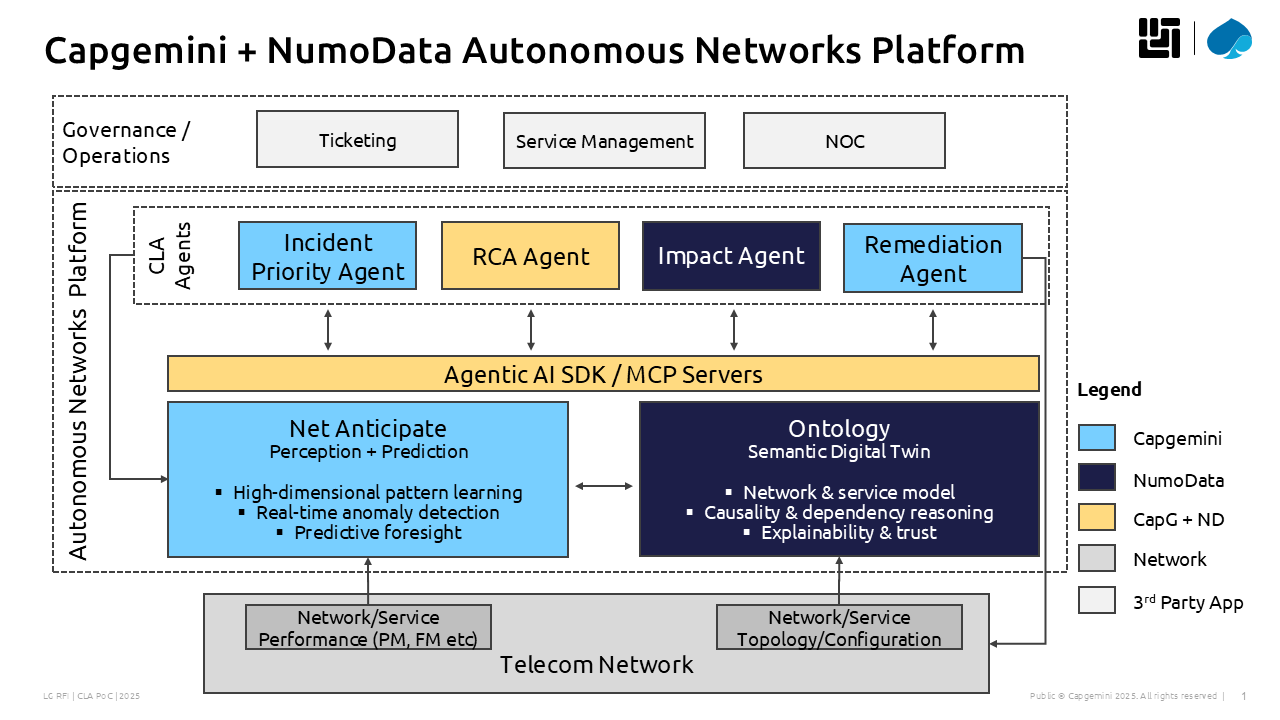
Figure 1 - Capgemini + NumoData Autonomous Networks Platform
Input Interface: Live network telemetry, performance metrics, fault data, topology, and configuration feed a clean, trusted view of reality that every analytics, AI, and automation layer builds upon. This single source of truth eliminates data silos that traditionally slow both teams.
Foundation Layer: Net Anticipate spots anomalies early and predicts where issues are likely to emerge, while the NumoData Ontology maps every network and service dependency, transforming raw signals into clear, explainable insights. This semantic foundation gives transformation teams confidence to deploy new services knowing the system understands dependencies, while operations teams receive automated guardrails that prevent changes from causing unintended impact.
Agentic Layer: Specialized agents handle prioritization, root-cause analysis, impact assessment, and remediation, working autonomously to maintain service quality while transformation initiatives roll out. They integrate with existing infrastructure via the Agentic AI SDK and MCP servers, turning insight into instant, closed-loop action without requiring operations teams to manually assess every change.
Operational Interface: Integration with ticketing systems, service management platforms, and network operations centers ensure human operators remain informed and in control, with the system handling routine monitoring, analysis, and remediation autonomously. This frees operations teams to focus on strategic optimization while giving transformation teams real-time visibility into network health and capacity.
The result: transformation teams deploy and innovate new services rapidly, confident that automated systems will detect and resolve operational issues proactively. Operations teams gain the deep visibility and predictive capabilities needed to maintain 24/7 resilience. Both teams work from a shared semantic understanding of the network, eliminating the traditional conflict between innovation velocity and operational stability.
The unified advantage: aligning transformation velocity with operational stability
The burden of ineffective and partial automation traditionally forces a choice between innovation and stability. Service providers must either slow transformation to maintain operational control, or accept higher operational risk to enable business agility. This solution eliminates that compromise.
Five principles that change everything
Proactive resilience: Shifts operations from reactive firefighting to predictive foresight, providing transformation teams the stable foundation they need to innovate while minimizing risk. Issues are recognized and resolved before they impact services or customers.
Autonomous cross-silo coordination: Agentic AI orchestrates complex detection, analysis, and remediation autonomously across multiple network layers, ensuring digital transformation initiatives are not stalled by manual, fragmented operational bottlenecks. Changes roll out faster because automated systems handle the operational complexity.
A unified semantic truth: By using a telecommunications-native ontology, the system provides a shared, explainable language for both operations and transformation teams, ensuring every automated decision is trustworthy and grounded in real-world network logic. Both teams work from the same understanding of dependencies and impact.
Business-outcome alignment: Realigns network performance with customer experiences and strategic business KPIs, ensuring teams work toward the same effective goals rather than optimizing disconnected technical metrics. Service quality, customer experience, and business objectives become unified measures of success.
Adaptive and aware design: Agents continuously assess their own performance and learn from outcomes, becoming progressively better at supporting both teams in achieving optimal business results. The system evolves with the network, adapting to changing conditions and requirements without requiring manual reconfiguration.
Experience the future at Mobile World Congress
Capgemini and NumoData are showcasing this autonomous network solution live at Mobile World Congress 2026. From real-time anomaly detection to automated remediation and predictive impact analysis, attendees can witness intelligence, automation, and semantic reasoning converging to create resilient, self-optimizing networks. This demonstration brings the theory of autonomous networks into practice, showcasing the tangible benefits of higher-level autonomy for operators and end users alike.