.svg)

NumoData Ontology is a semantic digital twin that maps every network relationship, dependency, and service layer into a single, living model. It delivers total network visibility and the AI-ready data quality that powers true closed-loop autonomy.

When every system speaks its own language, AI has nothing meaningful to work with. Gartner warns of widespread AI project failure driven by siloed, disconnected data. The result: point automations that go nowhere, and a closed-loop future that stays out of reach.
Siloed systems

Disconnected data

Different languages

Data fragmentation

Broken workflows

No path to value


As networks grow in scale and complexity, so does the volume of issues. Without context, issues become noise. Overwhelmed operations teams, mounting customer dissatisfaction, and reactive workflows become the default.
High volume of alarms

Lengthy investigations

Reactive workflows

Analyst burnout

Reduced efficiency

Customer churn

Graph infrastructure to store and traverse relationships across network data.
Semantic modelling to define meaning, rules, relationships, and inferences so that data becomes machine-understandable and able to power autonomous network AI.
Operational intelligence to turn that understanding into real outcomes: impact analysis, automation, and closed-loop decisions.
Autonomous networks demand more than a generic knowledge graph.
Every AI initiative lives or dies on data. Ontology guarantees a qualified, continuously reconciled foundation of network data, so your AI models reason on truth, not noise. Move past the hype. Build on what’s real.
Seamless operations.

Instantly simulate which customers and services are affected by any network event, change, or outage, and group them by priority. Act with confidence, not guesswork. Know before your customers do.
.avif)
Stop chasing symptoms. Ontology pinpoints root causes with surgical precision, cutting the costly delays and fractured war rooms that drive customer churn.
Plan better. Grow faster.

Establish optimal service paths for new customers in seconds. Accelerate order-to-sales cycles and secure new business without the bottleneck.
The understanding that protects every
layer of your network.

Safeguard unified policies across hybrid human and AI teams. Precise, real-time control of data, logic, and operations keeps your network secure as autonomy scales.
Scale with confidence. Stay secure.

Connect your existing stack without disrupting your ecosystem. Unify semantics without migration and add capabilities without replacing infrastructure.
No rip and replace.

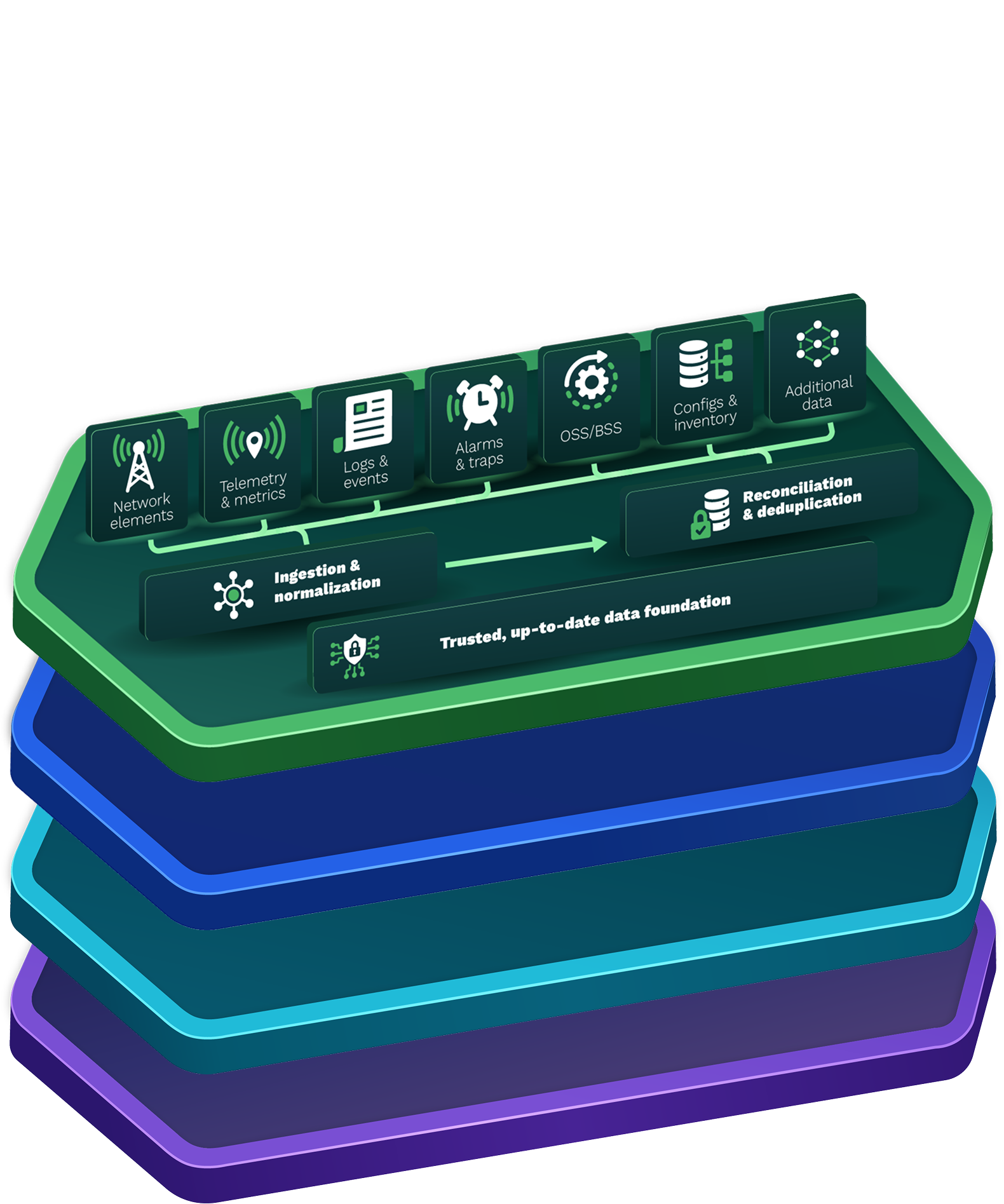
Continuously ingests and reconciles data across the entire network, giving AI a trusted, up-to-date foundation to orchestrate operations.
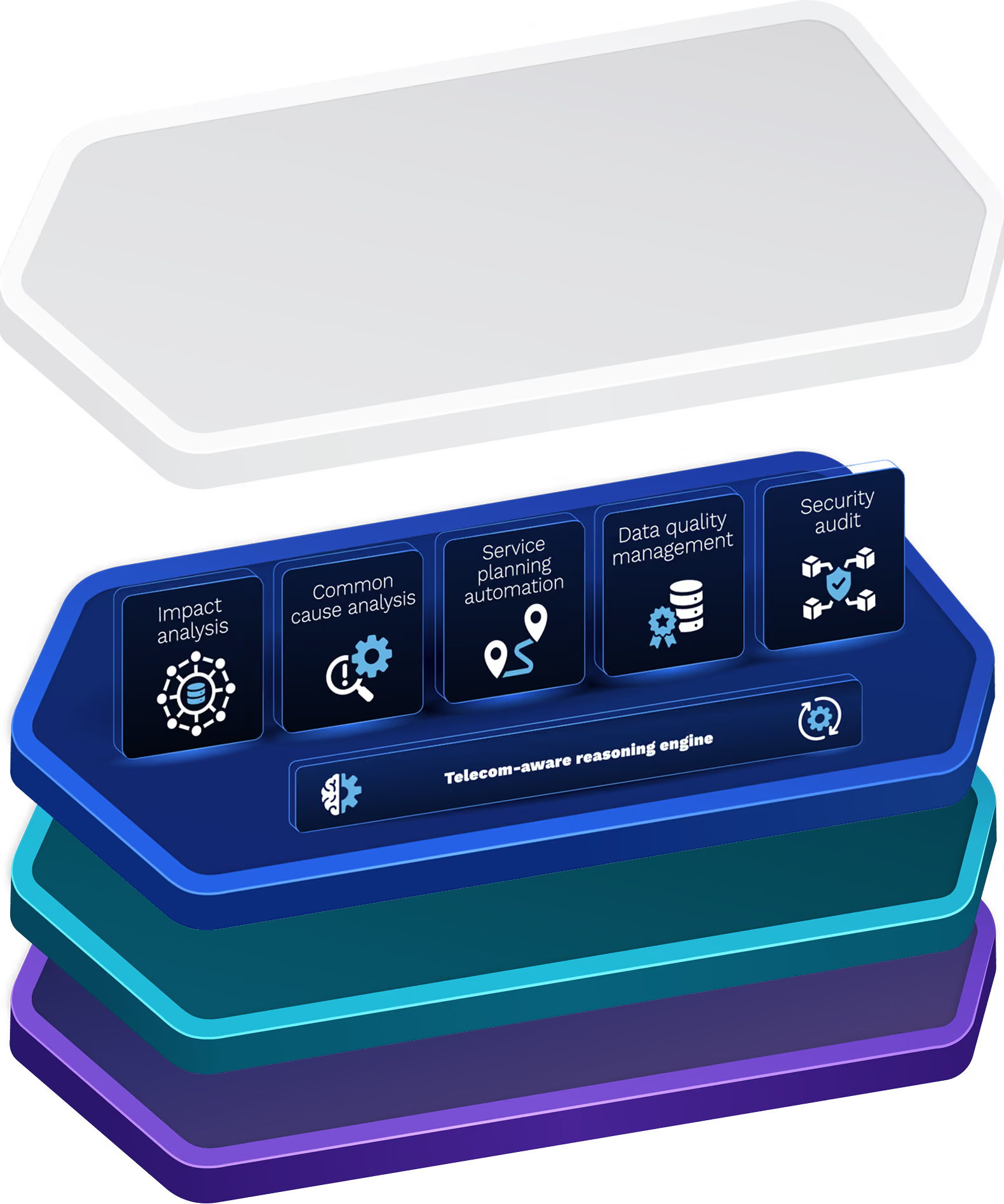
Applies telecom-aware reasoning, simulation, and validation to analyze service impact, identify root causes, and detect anomalies continuously.
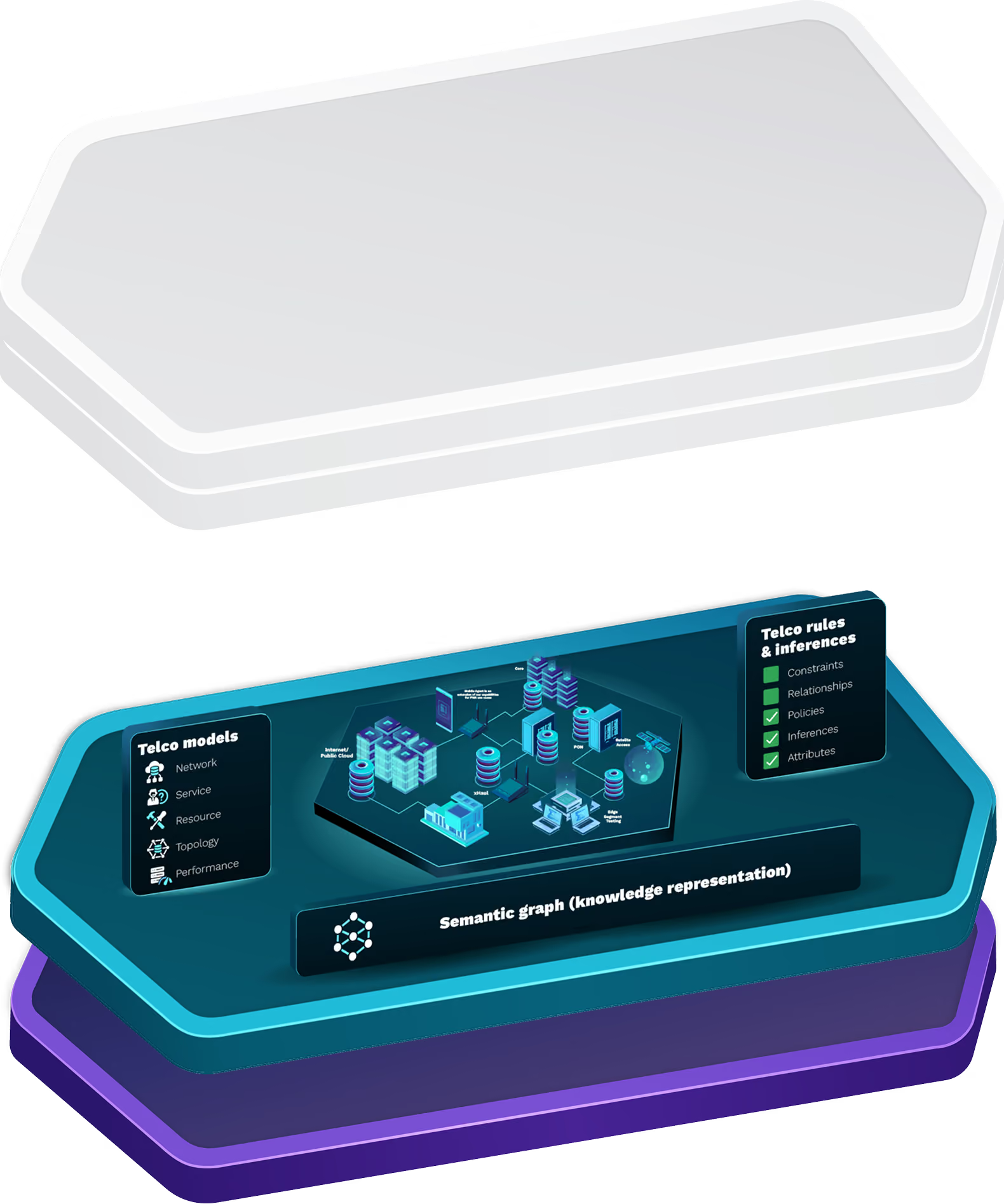
Flexible, telecom-specific prebuilt models aligned with domain rules and inferences. Creates a context-rich semantic digital twin of the live network.
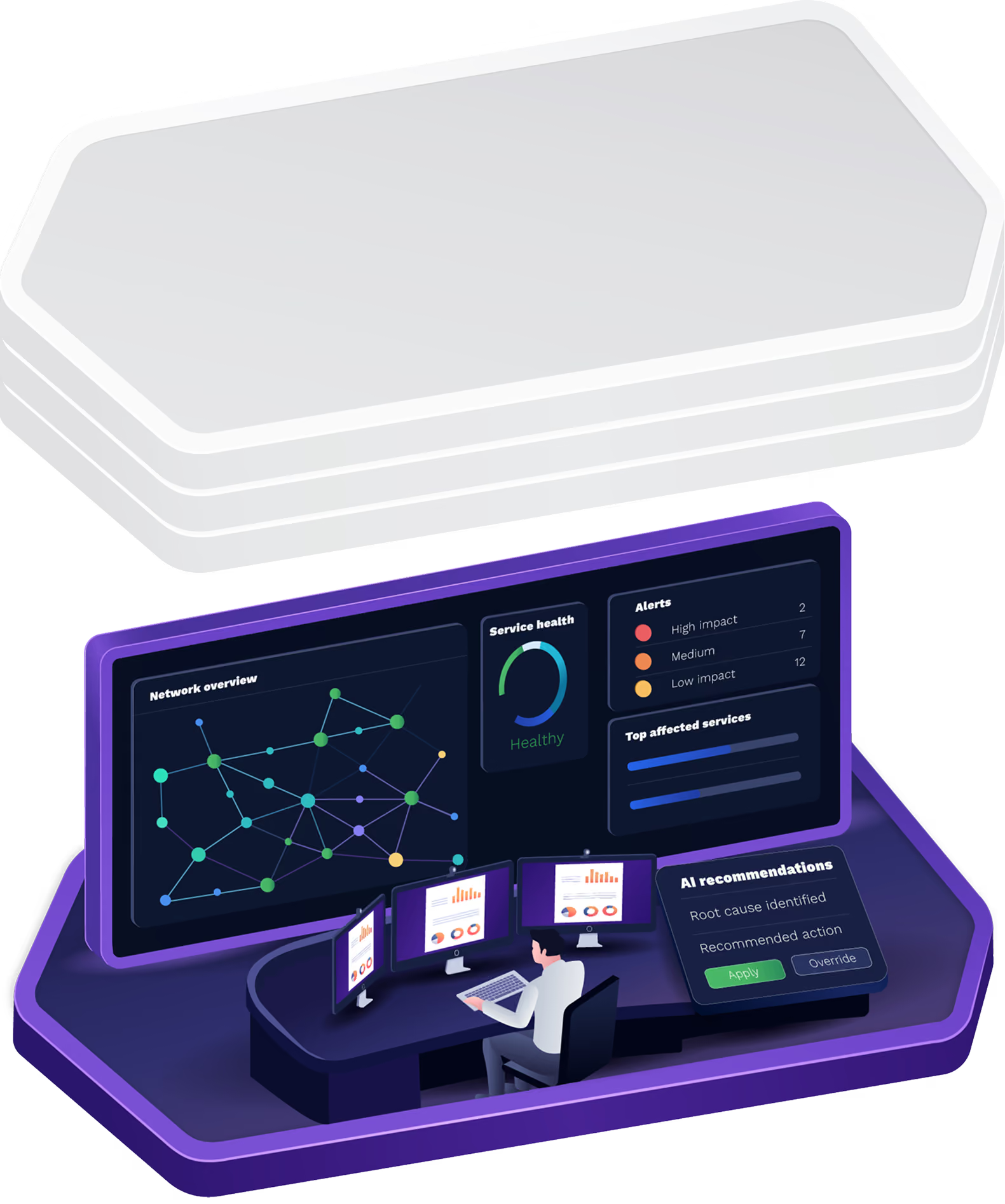
Real-time network visibility gives AI and Agentic AI the context to act. Human operators stay in the loop to review, override, or intervene only when and where it matters.

improvement in Mean Time to Understand (MTTU)
Creating complex enterprise service offers demands a complete, accurate view of the network across every domain. NumoData enables differentiated service offers grounded in real network data and significantly reduces order-to-cash timelines from weeks to minutes. Faster routes to revenue. New opportunities to grow.

faster Mean Time to Resolve (MTTR)
Once the common cause is isolated and confirmed with a high confidence, downstream AI can confidently find the remediation.

reduction in
customer churn
Service Impact Analysis finds and flags services that are "at risk" on backup capacity and triggers alerts before a ticket is ever opened, protecting SLAs in real-time.

improvement in root cause accuracy
Topology-driven common-cause analysis traces every physical and logical dependency and ranks the candidates with high confidence. Engineers get the proven cause not the best guess.

person-days saved in network planning
Ontology ideates, designs, and creates the optimal path to deploy services from operator to customer. This eliminates weeks of manual spreadsheet and map-tracing work.

millions in Capex
Ontology helps support better informed decisions on capital expenditure for network expansion through accurate network simulation, technology migrations, and different planning scenarios.

targeted response to security incidents
Continuous reconciliation between recorded and live network state exposes unmanaged devices, policy drift, and vulnerable assets across every vendor. The exposure gets prioritized before it becomes an incident, not discovered during one.

Faster order-to-sales. Vodafone streamlined network planning, improved root cause analysis accuracy by 75%, and increased right-first-time deployments by 35%, accelerating order-to-cash across the business.
Significant reduction in ticket volume. An 80% improvement in MTTR, 75% more accurate root cause targeting, and a 40% reduction in troubled tickets, driven by Ontology-powered operational intelligence.


Five operating companies. One Ontology. Telia unified five operations centers on a single Ontology-powered view, federated their inventory, and deployed service impact analysis tightly integrated with ServiceNow, setting the foundation for network autonomy.
Controlled costs. Unified services. MTN connected 15 operating companies through Ontology, federated inventory, and applied change and vulnerability analysis to cut infrastructure OPEX and strengthen service-level reporting.


A semantic digital twin is a live, vendor-agnostic replica of your entire network. It is built on a knowledge graph that models physical, logical, service, security, and business relationships as a unified semantic layer. Unlike traditional inventory tools, Ontology continuously ingests data from OSS, BSS, cloud, and third-party sources, reconciling and enriching relationships in real time to create a single source of truth for network understanding and decision-making.
CMDBs and legacy inventory systems store flat records in rigid relational databases that require manual reconciliation, a process that is slow and error prone. Ontology uses a live, schema-flexible knowledge graph with a semantic inference engine that automatically federates data from inventory, NMS, CRM, service catalogs, and cloud platforms, linking them semantically into a unified, end-to-end network model.
No. Ontology adds an intelligence layer on top of your existing OSS/BSS stack. It ingests data via standard adapters (SNMP, APIs, streaming, file imports) and enriches it without requiring changes to source systems.
Yes. Ontology integrates with NumoData’s GraphRAG engine to power an AI Knowledge Assistant that responds to natural language queries about network state, service impact, and change history with accurate, traceable answers. The Knowledge Assistant can operate in human-led or fully agentic workflows via MCP/A2A architecture.
A Dark NOC refers to fully autonomous, agentic network operations, a state where AI agents can detect, diagnose, and remediate issues without human intervention. Ontology serves as the semantic backbone that makes this possible, enabling a shift from reactive operations to proactive, intent-based autonomy.
Ontology ingests from a wide range of sources, including Operations Support Systems (OSS), Business Support Systems (BSS), real-time and event data streams, network and service domain data, orchestration systems, asset management platforms, semi-structured data such as device configurations and spreadsheets, and unstructured data such as free-text records and documents.
Yes, and it is often beneficial. Domain-specific digital twins can accelerate time to value, simplify deployment, and allow teams to focus on specific challenges. However, a multi-twin strategy requires careful governance: consistent data models, semantic alignment, and interoperability are essential to avoid fragmentation. For end-to-end use cases, an overarching twin is typically still required.
No. Most successful Ontology deployments start with a specific use case or domain, delivering targeted results quickly, then expand incrementally. This approach reduces risk, accelerates ROI, and keeps delivery aligned with business priorities.
Telecom data is rarely clean or complete. Ontology treats missing information as unknown rather than false, allowing the model to evolve as new data arrives. It uses matching rules and semantic inference to recognize when multiple systems describe the same device, link, or service, resolve conflicts, and surface data gaps, progressively building a more accurate, reliable network view without requiring a single monolithic inventory.