
Why network complexity is outpacing network understanding - and what to do about it
Networks are more complex, more interconnected, and more critical than ever. The operators pulling ahead aren't just investing more - they're building the network understanding that makes AI trustworthy, automation reliable, and every operational decision faster and more confident.
The illusion of progress
Telecom networks no longer just carry calls and internet traffic. They underpin how businesses operate, how critical services are delivered - and increasingly, how people organize their everyday lives. The stakes for how these networks are modelled, understood, and managed have never been higher.
The investment reflects that reality. Grand View Research estimates the global 5G infrastructure market at USD 41.4 billion in 2025, rising to USD 56.3 billion in 2026. Spending is accelerating.
But investment and progress are not the same thing. Most operators have automated routine tasks, partially connected workflows, and optimized individual domains. The harder problem - fragmented, inconsistent, and only partially trusted network data - remains largely unsolved. And the more automation is layered on top of it, the more visible that gap becomes.

Complexity that compounds
The pressure on operators is not simply that networks are getting bigger. It is that they are becoming more interconnected, software-defined, and operationally entangled at the same time - and those three forces compound each other.
The scale is significant. Ericsson reports that 5G subscriptions reached 2.9 billion by end of 2025 - one third of all mobile subscriptions globally - with 5G expected to overtake 4G as the dominant access technology by 2027. Cellular IoT connections reached 4.5 billion in 2025, growing 13.3% year over year and are expected to surpass 9 billion by 2030, with broadband and critical IoT accounting for around 2.6 billion of those. These are not incremental growth numbers. They represent a structural shift in what networks are asked to carry and connect.
The operational consequence is that experts are still manually stitching together context from siloed systems just to answer three basic questions: what failed, who is affected, and is it safe to proceed. At the scale and speed modern networks demand, that is no longer a viable way to operate.
Key takeaway:
The problem is not network growth. It is that the complexity that comes with that growth is outpacing the tools and models operators use to understand it.

Why more data is not more clarity
Many operators assume the answer is to centralize more data, connect more systems, or adopt a graph database. Those steps can help, but they do not solve the deeper problem on their own. A graph can store and traverse entities at scale. It does not automatically know what those relationships mean, which records represent the same real-world object, or whether a missing link is absent because it does not exist or because the source systems are incomplete. That distinction matters.
Telecom operations do not fail because there is too little data; they fail because there is too little trusted context. A fiber cut, a planned change, and a surge of alarms may all appear unrelated to siloed tools - even when they are part of the same service-impact story. Without a network model that understands both dependency relationships and meaning, operators are left with a graph of records rather than a model of behavior.
That gap between how the network behaves and how it is understood is the real bottleneck. Closing it requires something more than better data pipelines - it requires a fundamentally different way of modelling the network.
Key takeaway:
More data does not produce more clarity. Trusted context does - and most network models are not built to provide it.
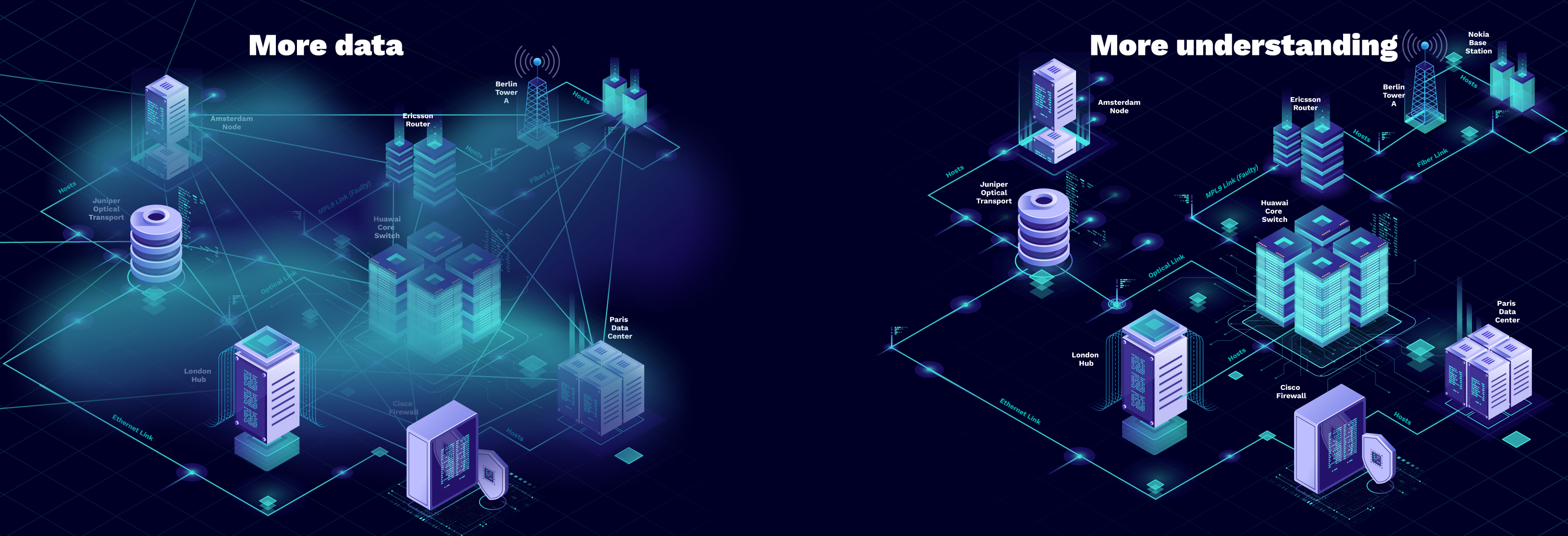
Semantic digital twins: turning network intelligence into operational decision-making
The real revolution in telecom will not come from deeper tool stacks. It will come from semantic digital twins: living operational models that reconcile physical, logical, service, business, and customer layers into one continuously usable representation of the network.
The difference from what exists today is significant. A network inventory tells you what assets you have - the equipment, the ports, the connections. A semantic digital twin tells you what they mean: which network element depend on which routes, where interdependencies create hidden risk, and what will happen to services and customers if one element changes. That is the shift from documentation to operational intelligence.
In practice, that intelligence works across three dimensions:
• Data reconciliation across systems - so different records are understood as the same router, port, service, or customer dependency, regardless of which OSS they originated in.
• Reasoning over incomplete or inconsistent data - allowing operators to infer missing relationships and validate what is likely true, rather than waiting for perfect data that never arrives.
• Consistently confident operational decision making - supporting impact analysis, root-cause investigation, capacity planning, security, and automation from a single trusted model.
The questions operators actually face are rarely "what is connected?" More often they are: what does this change affect, which customers are at risk, and is it safe to proceed? A network that can answer those questions in near real time is not merely better documented. It is fundamentally more governable, trustworthy, resilient, and reliable, delivering a better experience for every customer.
Key takeaway:
A semantic digital twin does not replace existing tools. It provides the missing intelligence layer - an end-to-end, real-time contextual view of the network, services, and customers, so every automated decision has qualified data to work from.

Intelligence in action
When the network is understood as a living system, the way operators work changes - not incrementally, but fundamentally. Three workflows illustrate this most clearly.
During outages, teams can move from alarm storms to impact-aware operations. Rather than treating every alarm as equal, operators can identify the shared dependency behind multiple symptoms and prioritize restoration based on which services and customers are actually affected. Mean Time to Detect (MTTD) and Mean Time to Repair (MTTR) improve not because teams work harder, but because they start from the right question.
During planned work, change windows defined by caution give way to changes governed by simulation. A router upgrade, fiber maintenance event, or core re-homing can be modelled in advance - giving the organization a clear view of likely impact before touching production. That reduces failed changes, lowers SLA risk, and creates a direct path toward safer automation.
During planning, the twin becomes a tool for capital discipline. With traffic, service dependency, and topology viewed together, operators can identify where capacity is genuinely constrained, where resilience is weak, and where legacy assets can be retired without hidden downstream consequences. In an environment of intense capital pressure, clarity becomes a form of cost control.
Key takeaway:
Understanding the network does not just improve visibility. It changes what operators can do - and how quickly they can do it safely.
AI will only be as smart as the network model beneath it
The industry is racing to embed generative and agentic AI into operations. The ambition is right - but the foundation matters more than the model. Large language models can generate fluent answers; they do not inherently understand a live telecom environment. Without a trusted context, they risk becoming eloquent hallucinators: confident, fast, and wrong.
The semantic digital twin is what makes AI trustworthy in a network context. It gives AI systems a governed representation of topology, service dependency, asset identity, and customer impact - a layer they can query rather than invent. In practice, that means a knowledge assistant can answer with confidence: which enterprise VPNs are exposed if a node is taken offline, which customers are affected by a software vulnerability, and where in the network the risk actually originates. NumoData Ontology provides exactly that grounded contextual layer - purpose-built for telecom, not adapted from general-purpose tooling.
The operators who win the next phase will not be those with the most advanced AI. They will be those with network models trustworthy enough for AI to act on safely. That is the difference between automation that accelerates confusion and automation that scales operational intelligence.
Key takeaway:
AI is only as reliable as the data it reasons over. In a telecom environment, that means the network model has to come first.
The quiet revolution
The shift that is coming is unlikely to announce itself in one dramatic moment. It will arrive through fewer outage calls that depend on the right expert being available, safer planned changes, faster root-cause analysis, and capital decisions made with clarity rather than approximation. The breakthrough will not simply be that networks become more advanced. It will be that they finally become understandable.
For years, operators have treated complexity as an unavoidable consequence of scale - something to manage around rather than solve. That assumption no longer holds. The combination of 5G growth, cloud-native architectures, expanding device counts, and deepening service-layer interdependence means complexity must now be modelled, reasoned over, and governed directly. Operators who build that capability now will not just operate more efficiently - they will make better decisions, faster, with greater confidence.
That is what Ontology makes possible. A semantic digital twin that gives every team, every system, and every automated process a single, trusted view of the network - from physical infrastructure to service layer to customer impact. Not a future ambition. Operational today, with some of the world's most demanding CSPs.
Discover how Ontology turns network complexity into the understanding that powers better decisions, trustworthy automation, and AI that actually works.